
Landmark EU Ruling Protects VPNs and Defines Geo-Blocking Boundaries in Anne Frank Copyright Case
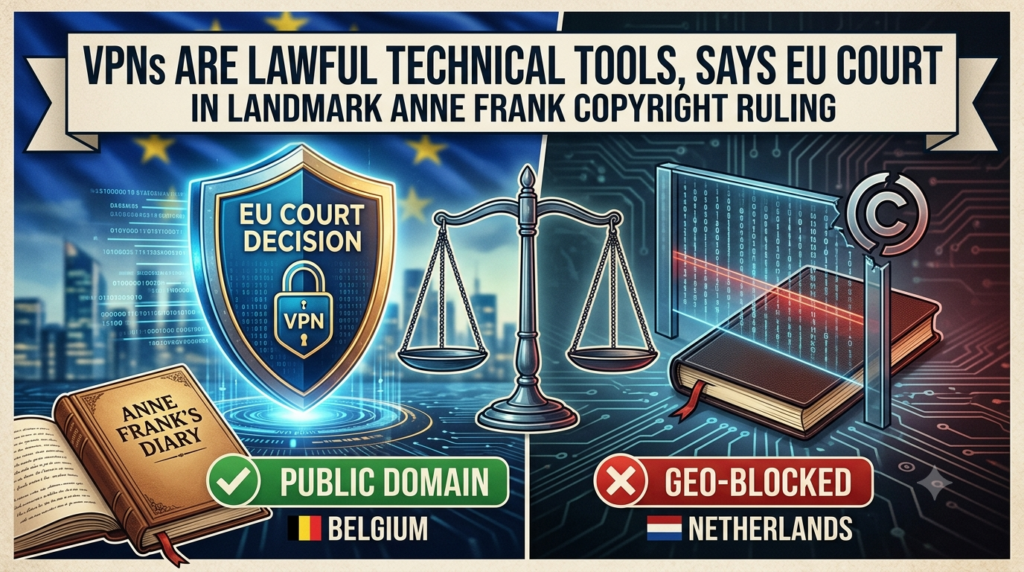
In a monumental decision for internet freedom and copyright enforcement, the Court of Justice of the European Union (CJEU) has officially categorized Virtual Private Networks (VPNs) as “lawful technical tools,” establishing a long-awaited boundary between digital copyright protections and user privacy.
The landmark judgment in Anne Frank Fonds v. Anne Frank Stichting and Others (Case C-788/24) resolves a complex, cross-border dispute regarding copyright territoriality, geo-blocking, and third-party software liability.
EU Court Rules VPNs Are Lawful
The conflict stems from the fragmented nature of copyright duration across Europe. While the historical manuscripts of Anne Frank entered the public domain in Belgium and roughly 60 other countries, specific rights remain protected by copyright in the Netherlands until 2037.
When a coalition of Dutch and Belgian academic institutions published a scholarly, free digital edition of the manuscripts, they hosted the site in Belgium. To respect Dutch law, the publishers implemented standard, state-of-the-art geo-blocking software designed to restrict access to visitors originating from Dutch IP addresses.
However, the Anne Frank Fonds, which holds the copyright in the Netherlands, filed a lawsuit against the publishers. They argued that because Dutch users could easily bypass geo-restrictions using commercial VPNs or proxy tools, the website was effectively committing copyright infringement within the Netherlands.
Key Takeaways from the Court’s Ruling
The CJEU ultimately dismissed the claim against the publishers, setting two major precedents for digital policy:
- Geo-blocking doesn’t need to be unhackable: The court held that a publisher fulfills its legal duties under EU copyright law by implementing standard, state-of-the-art location blocks. The theoretical or practical possibility that an end-user might actively bypass those blocks using circumvention tools does not, on its own, render the publisher’s security measures ineffective or unlawful.
- VPNs are reaffirmed as legal infrastructure: In explicit terms, Europe’s highest court recognized VPNs as legitimate, lawful technical tools. The ruling firmly rejects the notion that privacy tools should be legally classified or restricted as primary instruments of copyright infringement.
“The possibility of circumvention cannot, in itself and in all circumstances, be a decisive factor in finding geo-blocking measures to be inadequate.”
— Court of Justice of the European Union
What This Means for the Future of the Web
For years, copyright holders have pressured digital platforms to implement increasingly invasive, restrictive anti-circumvention measures, often targeting VPN providers in the process.
This ruling draws a clear line in the sand:
- Publishers are protected: Websites hosting location-restricted content are not liable for the deliberate circumvention actions of individual users.
- Privacy software remains safe: By cementing the legal status of VPNs, the CJEU shields privacy-preserving technologies from broader crackdowns under the guise of intellectual property protection.
The judgment is also likely to influence future disputes involving streaming services, digital libraries, academic archives, and other organizations that rely on geographic licensing restrictions. Rather than requiring providers to deploy impossible-to-defeat blocking systems, the court has confirmed that implementing reasonable, industry-standard safeguards is enough to satisfy their legal obligations.
For VPN providers, the decision represents an important legal affirmation that their services have substantial legitimate uses beyond bypassing geographic restrictions. Millions of Europeans rely on VPNs every day to secure public Wi-Fi connections, protect sensitive business communications, reduce online tracking, and safeguard personal privacy. The court’s acknowledgment of VPNs as lawful technical tools reinforces this broader role and may make it more difficult for future copyright disputes to portray the technology itself as inherently suspect.
As digital border enforcement becomes a centerpiece of global copyright strategy, the CJEU’s decision provides much-needed legal certainty for digital archivists, scholars, internet service providers, VPN companies, and everyday web users across the continent. While the ruling does not legalize copyright infringement, it makes clear that legitimate privacy technologies should not be treated as the problem simply because they can be misused by some individuals. That distinction could shape European digital policy for years to come.
Not all VPNs are created equal.
If this ruling has you considering a VPN, make sure you choose one that’s fast, trustworthy, and independently tested. Our VPN Reviews compare the industry’s biggest providers across speed, privacy, security, streaming performance, and value to help you make an informed decision.